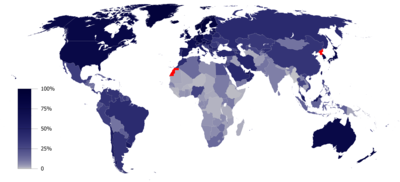
Firstly, the definition of “women’s rights” is essential. It refers to “freedoms and entitlements of women and girls of all ages” such as the right to vote, to work, to get equal pay as men, to own property, to get education, to have martial, parental and religious rights. Specific indexes, such as “Gender Equality” and “Women’s Suffrage”, can be reflections of the general term.
Different people have different ideas about "women's happiness". However, based on the Gender-Related Development Index , measures of well-being include life expectancy, education, purchasing power and standard of living, research shows that the best countries to be a women are:

While the Ten Worst Countries for Women are Afghanistan,Democratic Republic of Congo, Iraq, Nepal, Sudan, Guatemala, Mali, Pakistan, Saudi Arabia, and Somali.
This is a reflection of the happiest and least happy women in the world.
Among the top 10, Sweden is said to be a country in which women truly thrive. A 2005 report by the World Economic Forum found this Scandinavian nation to be the world's "most advanced country" for women, with greater levels of equality, power, health, and well-being among women than anywhere else.
This result is correspondent to Gender Equality ranking and Adults at High Literacy Level, in which Sweden is on top of the list.
 In an overview of higher education in Sweden, it is said that the rapid increase in female students is one of the most striking phenomena in all higher education systems, which implies that more Swedish females have the right to obtain higher education, compared to other countries.
This is a reflection of the happiest and least happy women in the world.
Among the top 10, Sweden is said to be a country in which women truly thrive. A 2005 report by the World Economic Forum found this Scandinavian nation to be the world's "most advanced country" for women, with greater levels of equality, power, health, and well-being among women than anywhere else.
This result is correspondent to Gender Equality ranking and Adults at High Literacy Level, in which Sweden is on top of the list.

 In an overview of higher education in Sweden, it is said that the rapid increase in female students is one of the most striking phenomena in all higher education systems, which implies that more Swedish females have the right to obtain higher education, compared to other countries.
These are good examples showing that Sweden is definitely one of those countries in which women have the most rights. As mentioned above, the Gender-Related Development Index measured based on life expectancy, education, purchasing power and standard of living – the possible components of happiness for women – shows that Sweden is the 6th best country in this category.
In the case of Swedish women, seems like they do feel happier if they have more rights. Then do women feel unhappy when fewer rights?
According to a survey, the people least satisfied with their lives are those in eastern and southern Africa, where one-in-five have a negative view of the future. Nine out ten worst countries are Islamic countries, which means Islamic women are the unhappiest. They are treated as second-class citizens at best. For example, in Afghanistan, men can marry up to four wives and can easily divorce their wives without court proceedings simply by repeating "I divorce you" in the presence of two male witnesses.
To conclude the information above, there does exist a relationship between women’s rights and their happiness. Women in countries which provide them with more rights tend to be much happier than the women who have very few rights in other countries.
However, sometime as women have different definition about happiness, they may have different standards of expectation. Maybe other examples can be found that in some less developed countries, women still feel happy even though they have fewer rights than those who are in developed countries.
According to a survey, the people least satisfied with their lives are those in eastern and southern Africa, where one-in-five have a negative view of the future. Nine out ten worst countries are Islamic countries, which means Islamic women are the unhappiest. They are treated as second-class citizens at best. For example, in Afghanistan, men can marry up to four wives and can easily divorce their wives without court proceedings simply by repeating "I divorce you" in the presence of two male witnesses.
To conclude the information above, there does exist a relationship between women’s rights and their happiness. Women in countries which provide them with more rights tend to be much happier than the women who have very few rights in other countries.
However, sometime as women have different definition about happiness, they may have different standards of expectation. Maybe other examples can be found that in some less developed countries, women still feel happy even though they have fewer rights than those who are in developed countries.